


If The Age of Reading Is Over, What Comes Next?
- Jul 23
- 6 min read
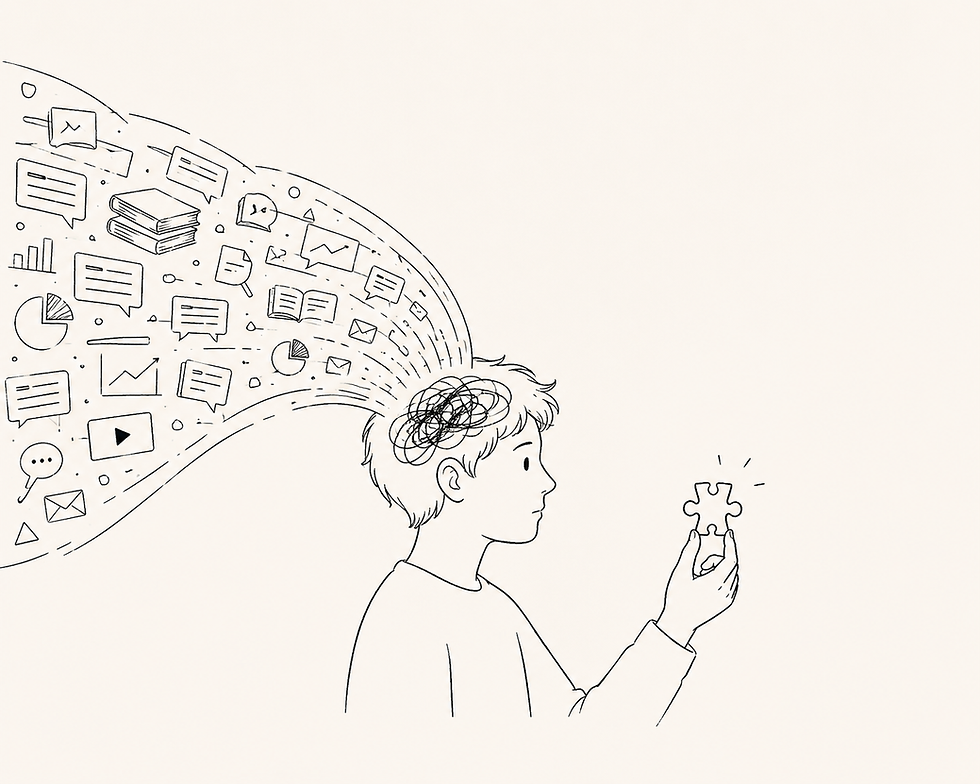
Last night I read an article by Rose Horowitch on the Atlantic titled “The Age of Reading is Over."
I expected another article blaming social media, smartphones and short attention spans for the decline of books. Instead, what I found was something much more thought-provoking. Horowitch wasn't simply arguing that people don't read anymore, instead she was asking whether we are witnessing the end of a period in history when reading was the dominant way human beings learned to think.
I also realized something rather odd, I probably read more words in a single day than my parents ever did in an entire week. Hell, make that months or years. Before leaving the house in the morning, I’ve probably gone through WhatsApp messages, emails, headlines, Instagram captions and whatever pointless argument people have decided to have on Threads. By the end of the day, I've consumed thousands upon thousands of words.
Yet despite all that reading and access to massive amount of information, none of us are actually more literate.
THE LEARNING IN READING
For centuries, perhaps, reading occupied a unique place in civilization. It wasn't and isn't merely a hobby or a form of entertainment, it was how educated societies processed complex ideas. Philosophy, law, science, religion, every thing the world has ever known was written and read. If you wanted to understand the world, there was very little alternative but to wrestle with difficult texts (and numbers). We followed arguments from beginning to end, reread passages we didn't understand and slowly pieced together another person's reasoning until it eventually became clear.
That process mattered because understanding was never instantaneous, but it demanded effort, patience and, perhaps most importantly, time.
Today, we still encounter an astonishing amount of information, more than we ever did in history, but we encounter it very differently. We skim articles instead of reading them, and we watch summaries of books we've never even opened. We can even listen to books. We consume opinions in thirty-second clips and feel strangely informed afterwards (Hi dad). In many ways, access to knowledge has never been easier, but yet I sometimes wonder whether easy access to information has quietly convinced us that understanding itself should also be easy.
Those are two very different things.
A few months ago, I wrote an essay about boredom and why I believed it was one of the most underrated ingredients of self-development. At the time, I was thinking about creativity, discipline and personal growth, but after eading Horowitch's article, it made me revisit that idea from an entirely different angle.
Every meaningful pursuit begins with a period where very little appears to be happening. A musician repeats scales for months before producing beautiful music, and I assume an athlete performs the same movements thousands of times before it becomes second nature, and entrepreneurs spend years solving small, unglamorous problems before anyone notices their success, and I believe, reading belongs in exactly the same category.
THE LOST VALUE OF BOREDOM
A good book rarely rewards you immediately. It asks you to trust that today's chapter will make tomorrow's chapter richer and it asks you to tolerate moments of confusion because clarity often arrives gradually rather than all at once. The tension of the plot unfolding before our very eyes. In other words, reading trains a quality that has become increasingly rare in modern life: the willingness to remain with something before demanding a reward.
Perhaps that is why boredom has become so uncomfortable.
We have become remarkably efficient at eliminating every empty moment from our lives. Waiting for a date? Check your phone. Standing in line? Scroll through Instagram. Sitting in traffic? Listen to a podcast. We have become so accustomed to constant stimulation that silence itself now feels like something requiring correction.
A friend once joked that the internet is probably what keeps young Indonesians from rioting because everyone is too distracted by whatever is happening online. "And that's a good thing," he added.
I laughed, and sadly, agreed.
The joke was funny precisely because there was a grain of truth hiding inside it. A society that is constantly entertained is also a society that has very little opportunity to become restless. Whether that is ultimately good or bad is another conversation, but I do wonder what happens when every quiet moment is interrupted before our own thoughts have had the chance to develop into something meaningful.
THE DECLINE OF OUR EDUCATION
One of the observations in Horowitch's essay that stayed with me long after I finished reading it had nothing to do with smartphones or social media. She notes that teachers and professors have quietly begun assigning fewer books, shorter excerpts and less demanding material because students increasingly struggle to complete long readings.
That struck me far more than any statistic, because I find that heart-breaking.
The important story isn't that students read less than previous generations, because every generation reads differently. The more significant story is that institutions themselves are beginning to adapt to the expectation that sustained reading is becoming unrealistic. Think about what that means for a second.
Universities or education in its essence, have traditionally existed to challenge the limits of our understanding. They were places where difficult ideas remained difficult because wrestling with them was part of the education. If universities begin lowering the amount or complexity of reading, not because the material has become less valuable but because students are less likely to finish it, then something much larger than personal preference is changing and that os: Education itself begins to evolve around a different kind of mind.
THE LOGIC OF EFFICIENCY
Horowitch also mentions that students increasingly ask professors to simply tell them what they need to know. I don't necessarily hear laziness in that request, but what I hear is the logic echoed in this modern world.
Everything around us encourages efficiency. From meetings, to audio books, to Artificial Intelligence, we have built an entire culture around reducing time between question and answer.
I use AI almost every day, and it is one of the most extraordinary technologies I have ever experienced. I can upload an entire book and receive a concise explanation within seconds, and I can ask it to compare philosophers, simplify legal documents or summarize academic papers that would otherwise take hours to read. In terms of efficiency, it is difficult to imagine a more powerful tool. But AI also forces us to ask a question that previous technologies never quite managed to ask so directly.
If a machine can explain every important book ever written, why should anyone still read them?
The most obvious answer is information, except information is no longer scarce in this era. Perhaps, information was never the true purpose of reading in the first place.
When I read When Breath Becomes Air, I am not simply learning about Paul Kalanithi's views on medicine, mortality or the meaning of life. I am walking beside him as he transforms from a neurosurgeon treating dying patients into one confronting his own death. The power of the book lies not in the conclusions he reaches, but in witnessing how those conclusions slowly emerge from his experiences.
The same is true of Babel. I could easily ask AI to summarize its plot or explain its central themes of language, colonialism and power. But a summary cannot recreate the gradual tension, moral conflict and intellectual journey that R. F. Kuang carefully builds over hundreds of pages. It can tell me what the novel is about, but it cannot replicate what it feels like to wrestle with the questions the novel asks.
A summary gives us conclusions, but a damn good book lets us participate in the reasoning that produced them.
That distinction feels increasingly important because modern life rewards conclusions while quietly discouraging the process of arriving at them ourselves.
WHAT KIND OF MINDS COME NEXT?
The more I reflected on Horowitch's essay, the more I realized that reading isn't the problem, it is simply where a much larger problem reveals itself: our growing intolerance for friction.
For generations, technological progress has been measured by how effectively it removes friction from our lives (and I thank the universe for that!) Cars removed walking, GPS removed navigation, Google removed hours spent looking through libraries and AI may soon remove much of the effort involved in organizing information and even forming first drafts of our thoughts.
None of those inventions are bad. In fact, most have improved our lives immeasurably, but every technology that removes effort also raises the same question. What human ability quietly weakens when we no longer need to exercise it?
Maybe, AI deserves the same conversation, but not because it will make us less intelligent, but because it may slowly persuade us that understanding the journey is optional as long as we possess the destination.
That is what stayed with me after finishing Horowitch's essay. I don't think she was mourning the decline of books, I think she was mourning the possible decline of a particular way of thinking.
Reading trained us to tolerate complexity, that worthwhile ideas often reveal themselves slowly and that understanding cannot always be rushed. Perhaps that is why the article feels so relevant today, because we often assume that every technological advance makes us unquestionably better.
History suggests something more complicated. Every tool expands certain abilities while quietly allowing others to atrophy, and the challenge has never been deciding whether new technology is good or bad, but recognizing what it asks us to trade in return.
If Horowitch is right, then perhaps the age of reading is coming to an end.
The question that interests me even more is this: What kind of minds will replace the ones that books helped build for the last hundreds of years?
Maybe the next generation will know everything, I’m just not sure they'll understand very much.

Comments