


Why Do Indonesians Love Private Companies? Just Visit a State-Owned One
- Mar 4, 2025
- 3 min read
Moving back to Indonesia, and actually living here has taught me many things—the most important among them is that if you have the choice, always opt for private companies over state-owned enterprises. I say this not out of disdain, but out of sympathy and most of all, disbelief at the level of incompetence the way things work in this country.
One winning trait that I can say where Indonesia should be proud of is probably, the service industry. The service industry here is generally fantastic, with hospitality being one of Indonesia’s strong suits. The people are warm, accommodating, and friendly, making everyday transactions smooth and enjoyable. But once you venture out into the wilderness that is the real world, anything controlled by the government—banks, insurance, transportation, traffic, utilities, the list goes on—you quickly realize that competence, efficiency, and transparency are not part of the equation.
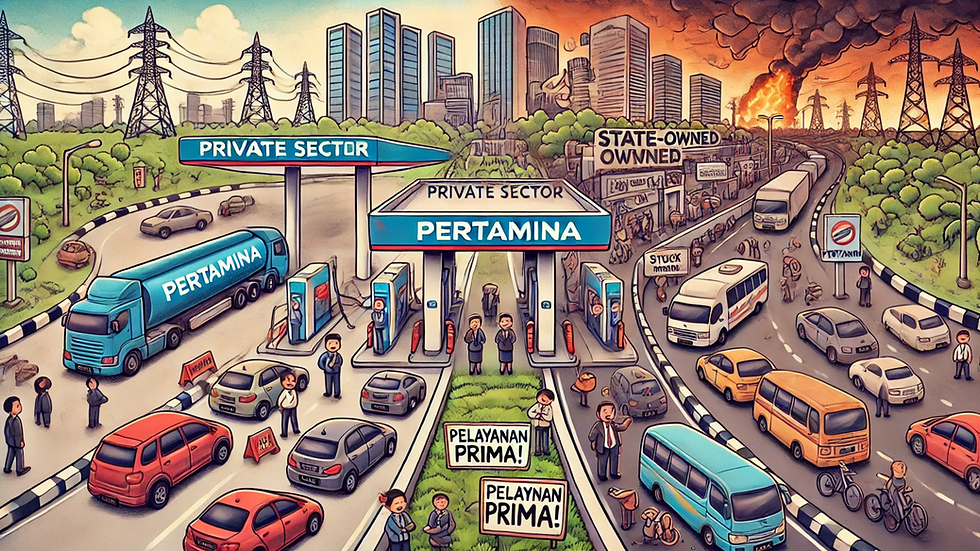
The reality of state-owned businesses in Indonesia is bleak: fraud, corruption, and incompetence run rampant. These enterprises operate not with the agility and customer-first mindset of private firms but with the sluggish inefficiency that stems from bureaucratic red tape and a deeply ingrained culture of complacency. Again, like I said many times, culture is what makes or breaks a civilization. Many state employees work just hard enough to not get fired, often displaying a laziness that stems from a job security they don’t feel the need to earn. And this is probably not their fault for this sort of similar theatrics can be found even among high ranking polticians. Deadlines are missed, problems are underestimated, and accountability is laughable.
This isn’t a rare occurrence—it’s the standard. Corruption is not the exception in Indonesian state enterprises; it is the rule.
Every few months, another scandal emerges involving billions siphoned off into the pockets of government-backed executives who will either escape punishment or serve a symbolic sentence before returning to the same corrupt cycle. Their prison cells? Probably better than most of Indonesia’s rented rooms.
The same pattern repeats: mismanagement, financial losses, and the people of Indonesia forced to bear the burden of incompetence. The worst part? People have grown numb to it. We even make jokes about it. Indonesians get more upset of Tik-Tok stars’ cheating spouse than we do over trillions of dollars being embezzled from the people. It’s just another day in Indonesia.
I recognize that I am privileged to be able to say this—to have the ability to choose private over public, to have access to better options when many do not. Not everyone has the luxury of avoiding state-owned businesses, especially those who live outside the cities.
But for those who can, there is no reason to subject yourself to their inefficiencies when better alternatives exist. I have friends who think that it is patriotic to buy from state owned businesses. I’m sorry, did I say friends? I meant, idiots.
When it comes to banking, insurance, and other financial services, private firms outperform government-run institutions in every possible way. You get faster service, better security, and a significantly lower chance of waking up one day to news that your bank has collapsed due to yet another corruption scandal. Trust me, my mother was a victim. She has learned her lesson.
Of course, some might argue, "But look at Temasek Holdings in Singapore!"—a government-linked company that thrives globally and operates with the efficiency of a world-class private firm. But let’s not kid ourselves: Indonesia is not Singapore, and it never will be. I’m sorry guys, that’s just the ugly truth.
The cultural, economic, and educational gaps between the two nations are staggering. Comparing Singapore’s meticulously structured governance to Indonesia’s chaotic bureaucracy is an insult to logic. What works there simply does not translate here, or as my Singaporean friend always said “Siao ah?”
So, what is the role of the government in business? I believe that truly depends on the country you live in. Most governments are bad for business, but they serve an important role in one segment and that is: Regulation—nothing more.
The government should exist to prevent unfair practices among private corporations, ensuring competition and protecting consumers. That’s the ideal way, but we know how reality works in this country. One day you’re filling gas for your car, the next day your car breaks down.
I didn’t write this to tell you that private businesses are better than state-owned ones (except, of course, I am). I write this to remind you that our government is already finding every possible way to get their hands on your hard-earned money—so the least you can do is not hand it over willingly.
But at the same time, I am a little frustrated of the long lines that have been building up at Shell Gas stations in Jakarta.
It’s almost poetic.

Comments